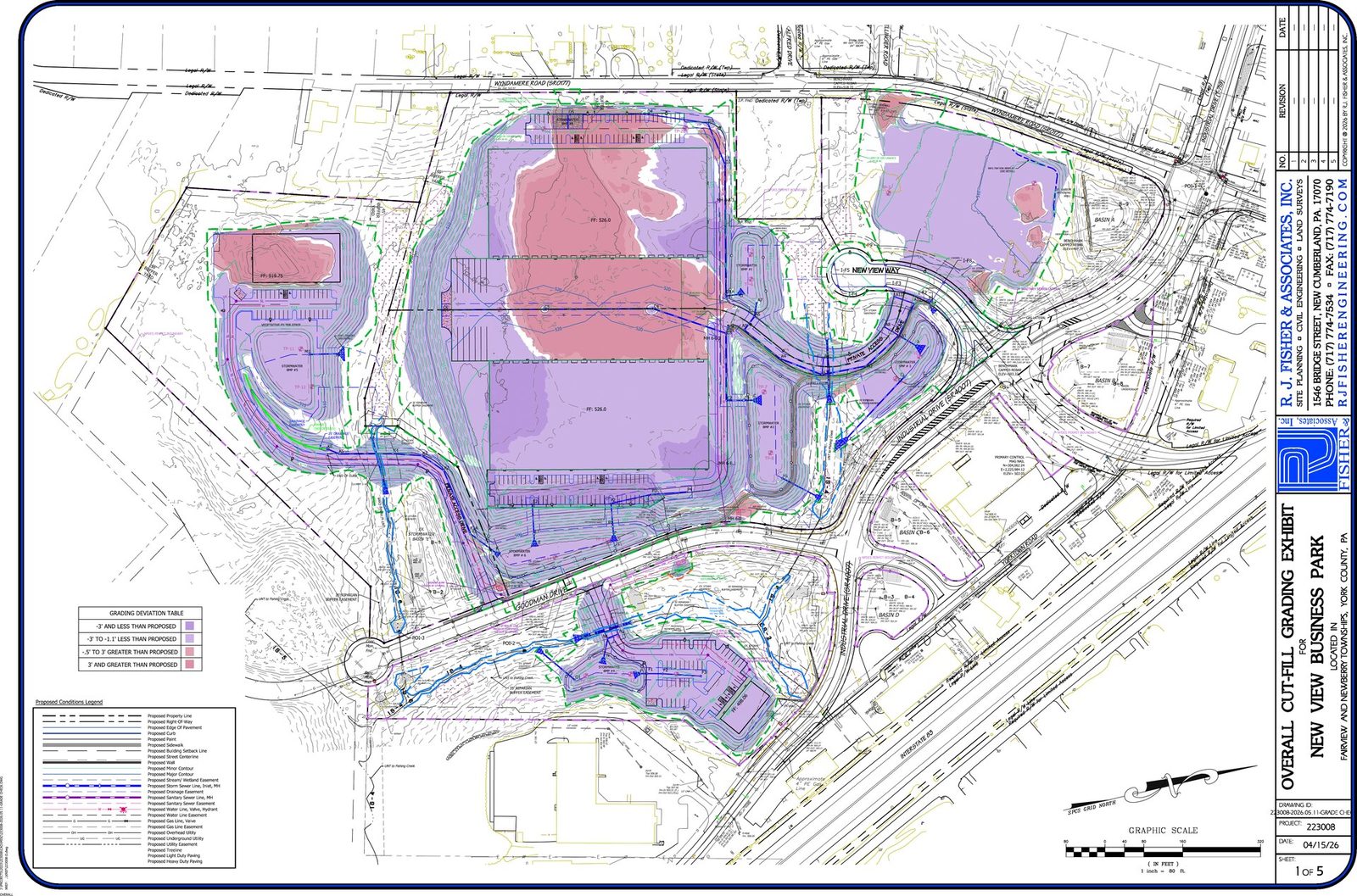
How close is New View Business Park to finished grade? As of the May 1 flight, the site earthwork is about 71 percent complete by volume. We know that because we flew it.
On May 1 we put a drone over the site and captured it with imagery and LiDAR. From that data we built a current ground surface and compared it, point for point, against the approved design grade. The exhibit shown here is the result: every part of the site colored by how far it still sits above or below finished grade.
Here is how to read it. The pink and rose areas are still above design grade, where cut remains. The purple areas are still below design grade, where fill remains. Anything left unshaded is essentially at finished grade. The lighter bands sit within roughly one to three feet of target. The darker bands still have more than three feet to go.
The site started with roughly 234,000 cubic yards of material to move. As of May 1, about 69,000 cubic yards of combined cut and fill remained, concentrated in a couple of areas while the rest of the site closes in on final grade.
The bands also show where the work is concentrated, not just how much is left. The deepest purple marks the areas carrying the most remaining fill, and the strongest rose marks the high ground still to be cut. A developer can see at a glance where the rest of the dirt is headed and sequence the work around it, rather than finding out a month from now.
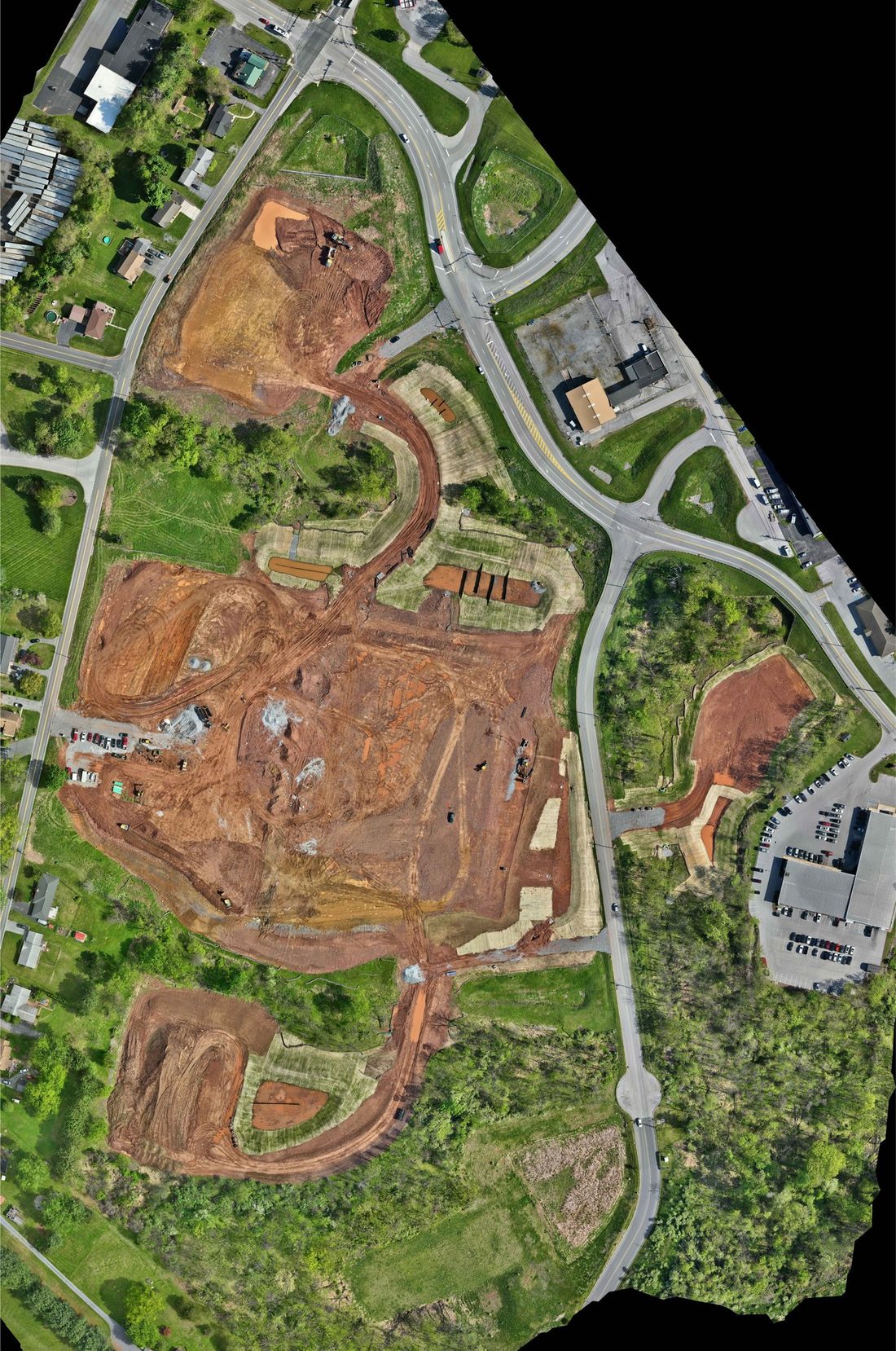
LiDAR is doing real work in those numbers. Because it returns points through light ground cover and along stockpile and slope edges, it produces a cleaner bare earth surface than imagery alone, which is what lets us measure to the foot rather than to the eye. Tied to ground control on the site, the comparison holds up as a figure a developer can build a schedule and a budget around.
For the developer, that is the value. One flight, no crews walking an active earthwork site, and you can see exactly where the job stands against the plan. You can check the contractor's progress against the pay schedule, catch any area drifting away from design grade before it becomes rework, and carry a defensible number for what is left to move. A grading job once tracked by windshield and gut feel is now measured against the actual design surface.
We run these progress flights on a set interval through construction, and the real power is in the comparison between them. Between the early April flight and this one, roughly three weeks apart, about 82,700 cubic yards of material moved and overall completion went from 35 percent to 71 percent. That turns a vague sense of progress into a rate you can project a finish date from. And once an area reaches grade, the same data becomes the record that it was built to plan.
If you are building a site and want this kind of read on where your earthwork really stands, we are always glad to talk it through.